SYSTEM_SERVICE_EXCEPTION stop code on Windows 10 and 11: what it means and how to fix it
In short
SYSTEM_SERVICE_EXCEPTION means a driver handed Windows bad data. Here is how to find which one, and the fixes in order from simplest to hardest.
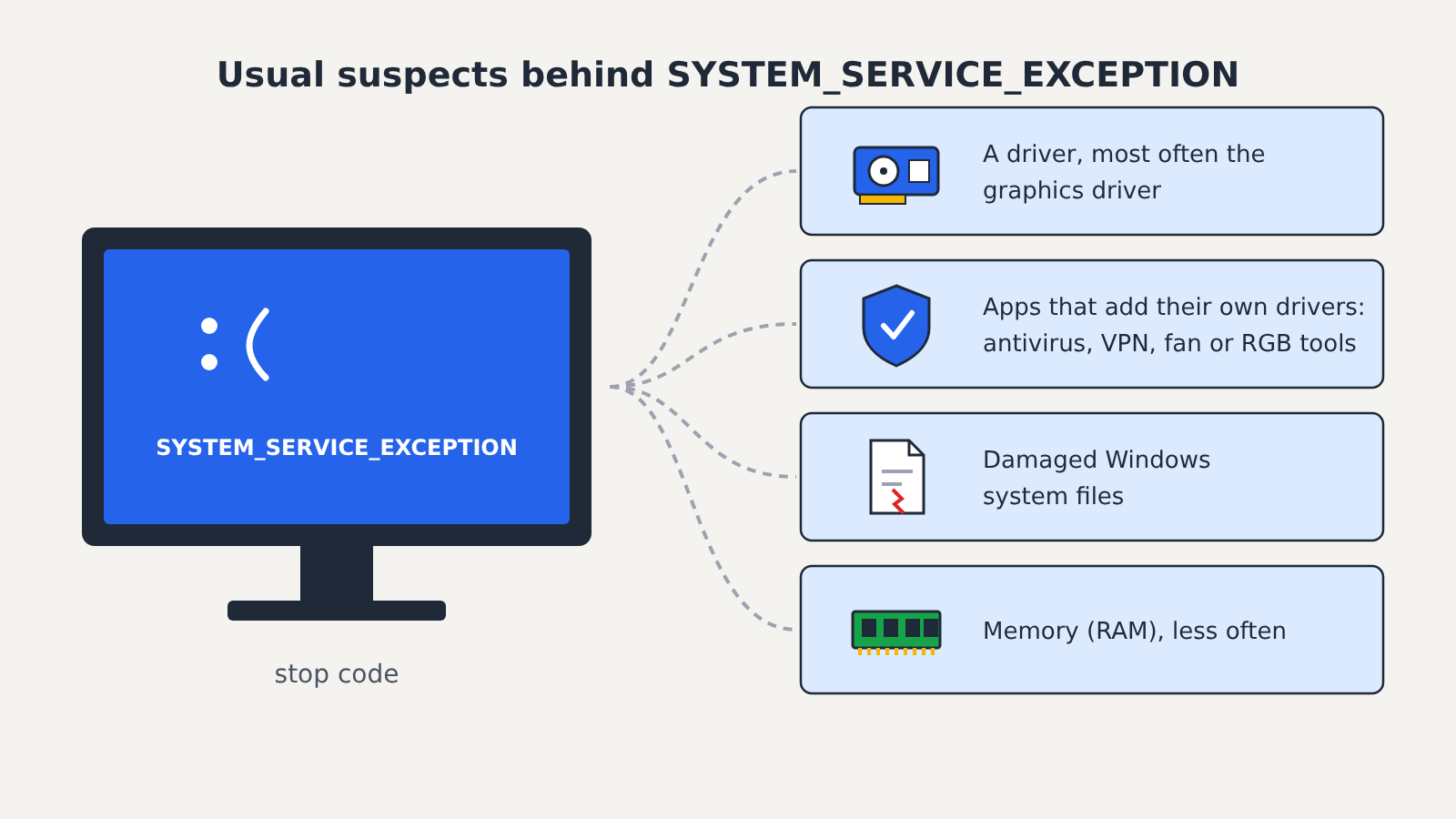
The stop code SYSTEM_SERVICE_EXCEPTION means a program or driver handed Windows' core (the kernel) something it couldn't process, at the exact moment the request crossed from ordinary software into the protected part of Windows. Rather than carry on with bad data, Windows stopped. One crash is not worth losing sleep over. If it keeps happening, it's a "fix soon" problem, and the cause is usually a driver, with the graphics driver at the top of the list.
It shows up on Windows 10 and Windows 11 as a blue (on some recent Windows 11 builds, black) screen reading "Your device ran into a problem and needs to restart", with Stop code: SYSTEM_SERVICE_EXCEPTION at the bottom. Microsoft documents it as bug check 0x0000003B ("Bug Check 0x3B: SYSTEM_SERVICE_EXCEPTION" on Microsoft Learn). If a crash report or Event Viewer shows 0x0000003B or 0x3B, it is the same error.
What the name means
Apps run in a walled-off area of Windows. When one needs something only the system can do, such as drawing to the screen, reading a file or talking to a device, it makes a "system service" call, and the request passes into privileged code. Microsoft's bug check page defines this error as an exception that happened while running a routine making that move from non-privileged to privileged code. In plain words: the hand-off went wrong.
Microsoft adds that the error has been linked to excessive paged pool use (a kind of memory the kernel uses) and that it may occur when graphics drivers pass bad data to the kernel. That matches what most people see: the crash tends to come during games, video playback, or right after a graphics driver update.

The "What failed" line is your best clue
Look under the stop code. Windows often adds a line such as What failed: nvlddmkm.sys. A file ending in .sys is a driver, and its name usually tells you whose it is:
- nvlddmkm.sys is the NVIDIA display driver; amdkmdag.sys or atikmdag.sys belong to AMD's graphics driver.
- Files from your antivirus, VPN, or a fan, lighting or overclocking tool point at that program.
- win32kfull.sys, win32kbase.sys, ntoskrnl.exe or dxgkrnl.sys are parts of Windows itself. They are rarely the real culprit; they're where the bad data landed. Treat those as "a driver or damaged system files" and work through the steps below.
If the screen vanished before you could read it, search the Start menu for View reliability history. Reliability Monitor lists each crash by date, and its details often show the bug check code and the file involved.
Is it urgent?
Not an emergency. Your files are not at risk from the stop code itself, but every crash closes your apps without saving. Save often until it's fixed, and back up anything important if the crashes are frequent.
Anything that offers to fix it by phone is a scam: a real stop code never shows a phone number. Our guide to the fake virus warning pop-up with a phone number shows what those look like.
Fixes, from simplest to hardest
If Windows crashes too quickly to try these, start in Safe Mode: hold Shift while you click Restart, then choose Troubleshoot > Advanced options > Startup Settings > Restart and press 4 (or 5 for Safe Mode with networking, which you'll need to download a driver).
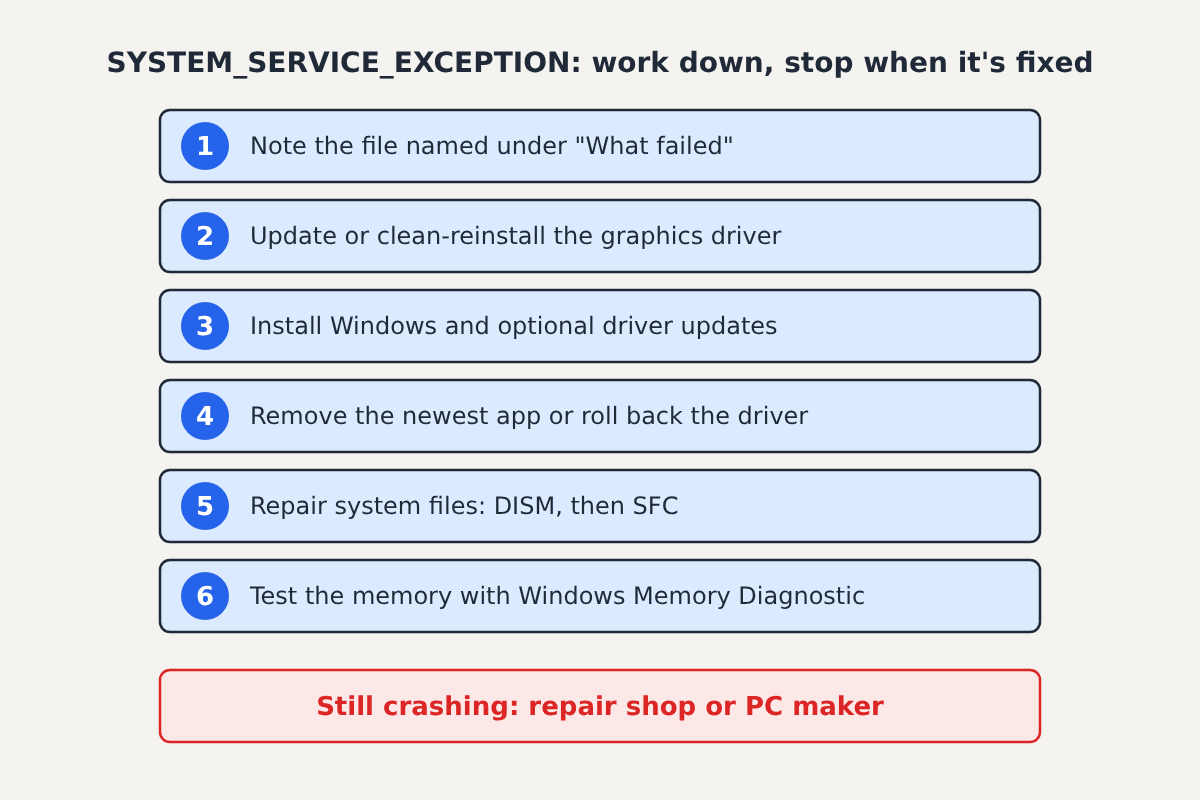
1. Note the file and when it happens
Write down the file under "What failed" and what you were doing: gaming, waking the PC from sleep, plugging in a device. A crash that only happens in one game or after sleep narrows things down fast.
2. Update or reinstall the graphics driver
Download the current driver for your graphics card from NVIDIA, AMD or Intel, or from your laptop maker's support page (laptop makers sometimes ship customised versions). Choose the clean-install or factory-reset option in the installer if it has one, so the old driver's settings are wiped. If the crashes started right after a driver update, do the opposite: open Device Manager, expand Display adapters, double-click your graphics card, and on the Driver tab choose Roll Back Driver.
3. Install Windows and driver updates
Go to Settings > Windows Update, install everything, then open Advanced options > Optional updates and install any driver updates listed there. Restart even if Windows doesn't ask.
4. Remove the newest app or driver
Think about what changed just before the crashes began. Antivirus suites, VPN clients, and fan, lighting or overclocking utilities all install their own drivers, which run in exactly the privileged area where this error happens. Uninstall the most recent one in Settings > Apps > Installed apps, restart, and see if the crashes stop. If you removed third-party antivirus, Microsoft Defender switches back on by itself. If a Windows update is the trigger, you can remove it in Settings > Windows Update > Update history > Uninstall updates.
5. Repair system files
Right-click the Start button and open Terminal (Admin) (on Windows 10, Windows PowerShell (Admin)). Run these two commands, one after the other, and let each finish:
DISM /Online /Cleanup-Image /RestoreHealth
sfc /scannow
DISM repairs the store of Windows files that SFC uses, so run it first. Restart afterwards.
6. Test the memory
Faulty memory is a less common cause, but worth ruling out once software fixes have failed. Search the Start menu for Windows Memory Diagnostic, choose Restart now and check for problems, and read the result after Windows starts again. Any error means a memory problem; our guide to the MEMORY_MANAGEMENT stop code explains what to do next.
When to get help
If the crashes continue after all six steps, or Windows won't start at all, take the PC to a repair shop or contact its maker, and mention the stop code and any file from the "What failed" line. A technician can read the crash dump (saved in C:\Windows\Minidump) to name the driver exactly. If Windows can't reach the desktop, our INACCESSIBLE_BOOT_DEVICE guide shows how to get to the recovery screens, and the IRQL_NOT_LESS_OR_EQUAL guide covers a close relative of this error that is also usually a driver.
Sources: Microsoft Learn: "Bug Check 0x3B: SYSTEM_SERVICE_EXCEPTION"; Microsoft Support: "Troubleshoot blue screen errors", "Advanced startup options (including safe mode)", "Windows Memory Diagnostic".
