Battery warning light comes on while driving: what it means and how far you can go
In short
A red battery light with the engine running means the car has stopped charging its battery, usually an alternator or belt problem. Here is what to switch off, what to check and when to stop.
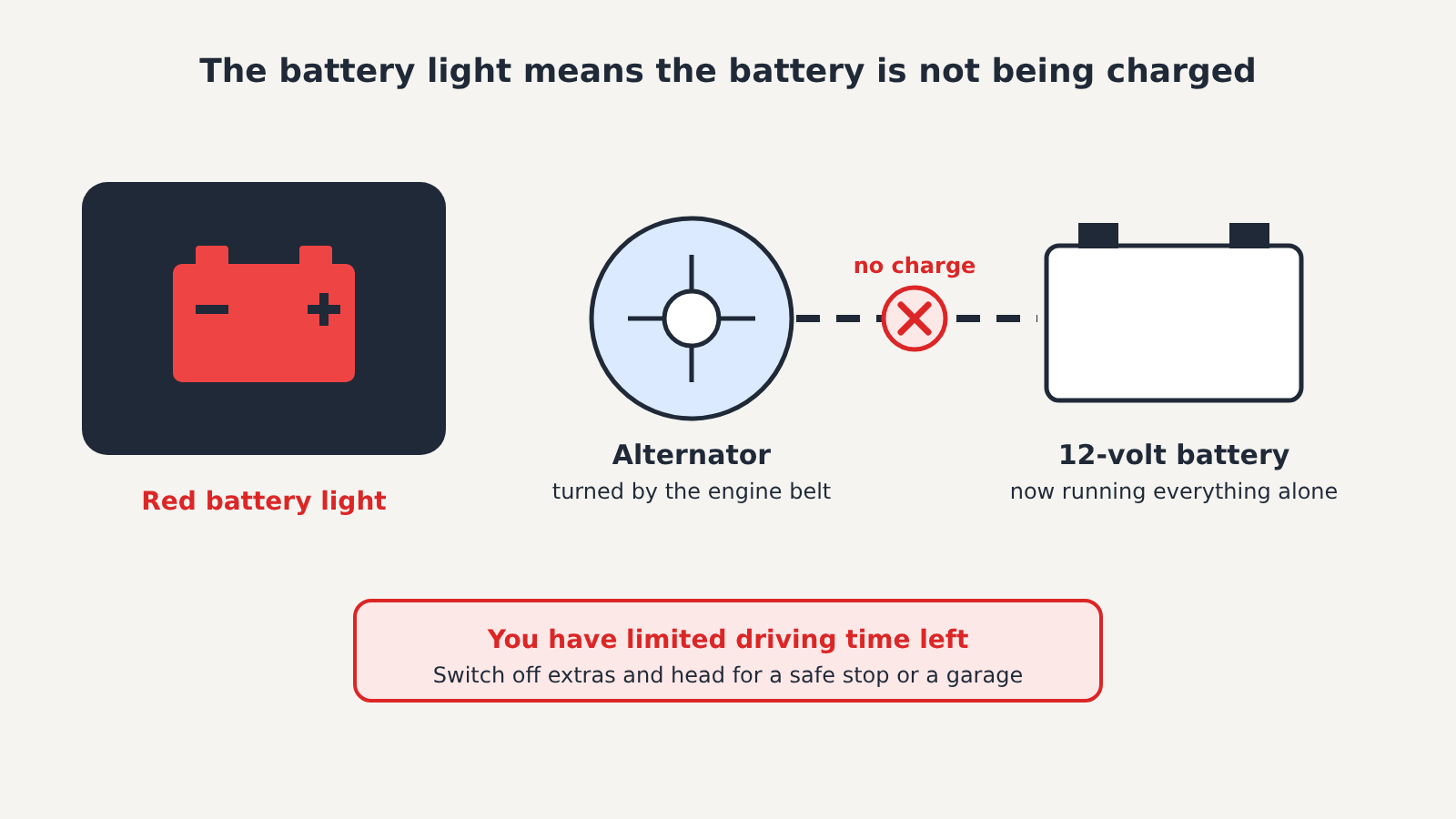
A red battery light that comes on while the engine is running means the car's charging system has stopped charging the battery. It is rarely the battery itself. Treat it as "act now": the car is running on what's left in the battery, and when that runs out the engine and electrics will stop, so you have limited time to get somewhere safe.
The symbol is a red rectangle with two terminals and a plus and minus sign. Some cars show a message instead or as well, such as "Charging system fault" or "Check charging system"; the wording depends on the make, and your owner's manual lists the exact messages for your model. This guide applies to petrol and diesel cars. Hybrids and electric cars use different warnings for their high-voltage battery, covered in their manuals.
Normal at start-up, a fault while driving
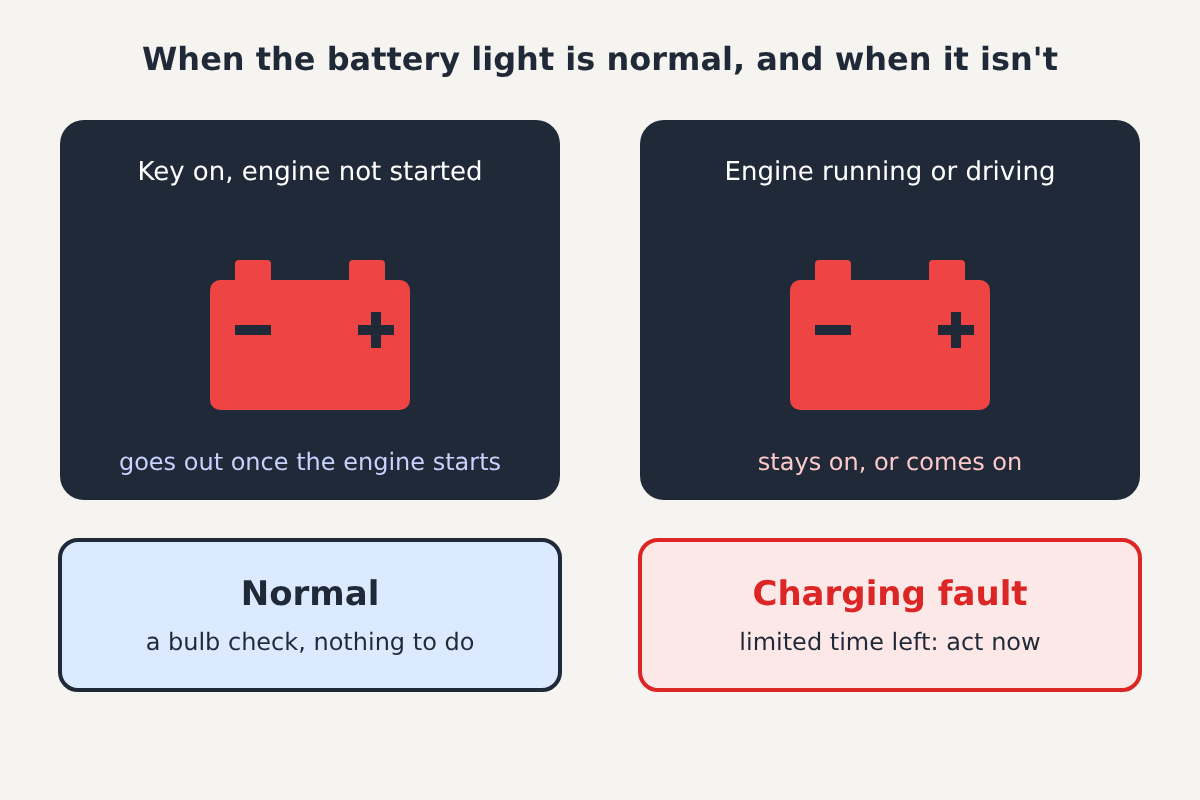
When you switch the ignition on, most warning lights come on for a moment as a self-test, and the battery light stays lit until the engine starts. That's normal. It should go out a second or two after the engine fires. If it stays on with the engine running, or comes on while you're driving, something in the charging system has failed.
What's happening
While the engine runs, a belt turns the alternator, a small generator that powers the car's electrics and recharges the 12-volt battery. The battery light is really a charging warning: it comes on when the alternator's output drops below what the system needs. The usual causes are:
- A broken or slipping drive belt. On many engines the same belt also drives the water pump and power steering pump, which makes this the most urgent case (see below).
- A failed alternator or its voltage regulator.
- A loose or corroded battery terminal or cable, or a blown fuse in the charging circuit.
- A battery that's failing, less often, which can upset the charging system.
What to do now
- Switch off everything you don't need: heated seats and screen, rear window heater, climate control fan, seat heaters, the radio and phone chargers. Keep headlights on if you need them to be seen. Every amp you save buys more driving time.
- Don't switch the engine off unless you've reached your stop. With a dead charging system the battery may not have enough left to start the car again.
- Head for a safe place or a nearby garage. How far you can get depends on the battery's state and what's switched on, and there's no reliable figure. Don't plan on a long journey; aim for the nearest place you'd be happy to leave the car.
- Watch the other gauges. If the temperature gauge climbs or a red temperature light comes on, or the steering suddenly becomes heavy, the belt has probably broken. Pull over as soon as it is safe and switch off: an overheating engine can be badly damaged.
Signs the battery is running out: lights dimming, the radio cutting out, warning lights flickering, the engine stuttering. At that point, pull over safely while you still have power for hazard lights, and call for roadside assistance.
What to check when you've stopped
With the engine off and the key out, open the bonnet and look, without touching anything hot or near the fan:
- The drive belt, at the front or side of the engine. If it's missing, shredded or hanging loose, that's the cause. Don't drive on; the car needs a tow.
- The battery terminals. A loose clamp or a crust of white or green corrosion can stop charging. If a clamp moves by hand, that may be your answer, but leave tightening and cleaning to a garage or roadside mechanic unless you've done it before: battery acid burns and a spanner across the terminals can short the battery.
If you can't see a problem, don't guess. A garage or roadside service can test the battery and alternator output in a few minutes with a meter.
Can you keep driving?
Short distances, to a safe stop or a garage, as long as the temperature gauge stays normal and the steering feels as usual. Don't keep driving to see if it clears up, and don't set off on a motorway trip with the light on. If the belt has broken, the engine is overheating, or the car is struggling for power, stop and get it towed.
Jump-starting a car with a charging fault only gets it going again until the battery drains, which may be minutes. It's a way to move the car a short way to a garage, not a fix.
If the oil can symbol is the red light you're seeing instead, read what the red oil pressure light means: that one means stop immediately. For amber lights, a flashing or steady check engine light is about engine management, not charging.
