Check engine light: steady versus flashing, and whether you can keep driving
In short
A steady check engine light means get it checked soon; a flashing one means a misfire that can damage the engine and exhaust, so slow down and stop. What each means, the fuel-cap check, reading the code, and when to call a tow.
A check engine light means the engine computer has found a fault in the engine, fuel, ignition or emissions system and stored a trouble code for it. A steady light means "get it checked soon"; a flashing light means the engine is misfiring badly enough to cause damage, so slow down and stop as soon as you safely can.
This applies to any petrol (gasoline) car or light truck sold in the US since the 1996 model year, all of which carry the OBD-II self-diagnosis system the light belongs to, and to similar systems in other markets. Manuals call it the "malfunction indicator lamp" or MIL. It is amber or yellow, and shaped like an engine block, sometimes with the word CHECK or "CHECK ENGINE" under it. The exact advice below comes from Honda, Ford and Kia owner's manuals and the US EPA; your own manual has the final word for your model.
How urgent is it?
| What you see | What it means | What to do |
|---|---|---|
| Light comes on with the ignition, then goes out | Bulb check at start-up | Nothing, this is normal |
| Steady amber light while driving | A fault has been detected and a code stored | Fix soon: book a code read in the next few days |
| Flashing amber light | Active engine misfire | Stop now: ease off, pull over safely, don't keep driving at speed |
| Check engine light plus a red oil, temperature or brake light | Something more serious is going on | Stop as soon as it is safe and switch off |
The difference between steady and flashing is the single most important thing to notice.
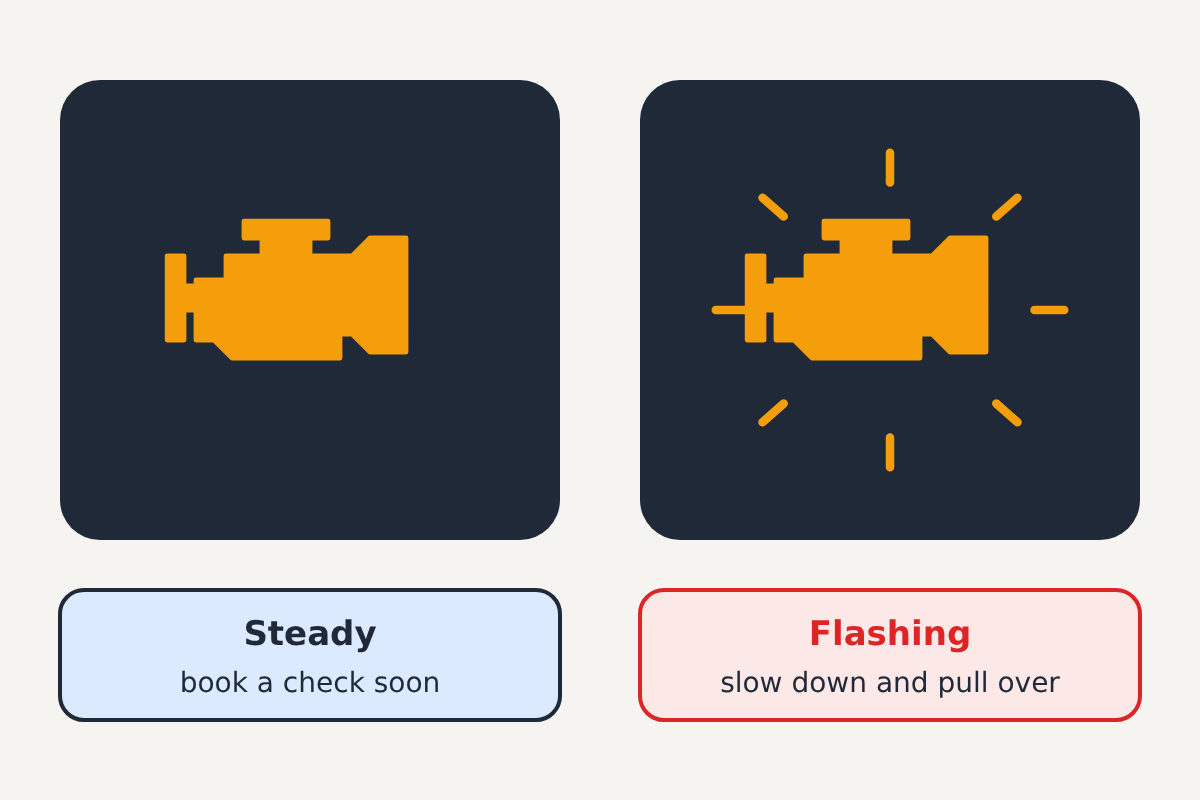
If the light is flashing
A flashing light means the engine computer has detected a misfire: one or more cylinders are not burning their fuel properly. Unburned fuel then goes into the exhaust, where it can overheat the catalytic converter. Honda's owner guides describe a blinking malfunction indicator as engine misfiring, and the instructions in them are clear:
- Avoid sudden acceleration and high speed. Don't try to "push through" to get home.
- Pull over where it is safe, away from dry grass or anything else that could catch fire under a hot exhaust.
- Switch the engine off and let it cool. Honda's HR-V guide says to stop for 10 minutes or more.
- If the light blinks again when you restart, Honda's guidance is to drive gently to the nearest dealer at no more than 31 mph (50 km/h). If that means highway driving, or the car shakes, loses power or smells hot, call for a tow instead.
Signs that go with a misfire include the car shaking at idle, stumbling when you accelerate, or a sudden loss of power. If you notice smoke, a burning smell or a fuel smell, stop, switch off and get everyone out of the car.
If the light is steady
A steady light is not an emergency, but it is not a light to live with either. Honda's manuals warn that driving for a long time with the indicator on can damage the emissions control system and the engine, and a steady light can hide a second fault that turns up later. In many US states a car with the light on will also fail its emissions inspection.
Work through these from simplest to hardest:
1. Check the fuel cap
A loose or missing fuel cap is a known cause, because the system checks the fuel tank for vapour leaks. If the light came on soon after you filled up, open the fuel door and tighten the cap until it clicks (Honda says several clicks); replace it if it is missing or the seal is cracked. Some cars show a separate "Check fuel cap" message first.
The light won't go out straight away. Ford's manuals say it should switch off after about three driving cycles without the fault, where a driving cycle is a start after the engine has been off for four hours or more, followed by normal city and highway driving. Honda manuals give anything from one trip to several days of driving depending on the model. If it stays on after that, the cap was not the cause.
2. Notice how the car drives
Is it running normally, or is it rough, slow to start, using more fuel or making new noises? Note when the light came on: after filling up, in heavy rain, after a cold start, after a repair. A mechanic will find that useful, because the stored code says which system reported the fault, not always which part has failed.
3. Get the code read
Every OBD-II car has a diagnostic socket under the dashboard on the driver's side. A scan tool plugged into it reads the stored code, such as P0300 (random or multiple misfire) or P0420 (catalytic converter efficiency below threshold). Garages, dealers and many auto-parts stores can read it, and cheap Bluetooth readers work with a phone app.
A code is a starting point. P0420, for example, can come from a worn converter, but also from an oxygen sensor or an exhaust leak, so be wary of anyone who wants to replace an expensive part on the strength of the code alone.
4. Get the fault repaired
Common causes behind a steady light include the fuel cap, oxygen sensors, spark plugs and ignition coils, a vacuum leak, the mass airflow sensor and the evaporative emissions system. None of these needs to be fixed at the roadside, but all of them are jobs for a mechanic or a confident home mechanic with the right manual.
Don't just clear the code
A scan tool can switch the light off, and so can disconnecting the battery on many cars. Neither fixes anything: if the fault is still there, the light comes back. Clearing it also wipes the stored "freeze frame" data a mechanic would use, and it resets the readiness monitors that emissions inspections check, so a car that was just cleared will usually be turned away until it has been driven enough for the system to re-test itself.
When to stop and when to call someone
- Stop driving now if the light is flashing, if it comes on together with a red oil pressure, temperature or brake warning, or if the car loses power, shakes hard, smokes or smells of fuel.
- Call a mechanic or dealer if the light stays on after you've checked the fuel cap and driven a few days, or if it keeps coming back after being cleared.
- Check for open recalls using your vehicle identification number (VIN) on the NHTSA recall lookup or your manufacturer's site; some engine and emissions faults are covered by a recall or an extended emissions warranty.
The other amber light that often worries drivers is the tire pressure warning, which also has a steady and a flashing mode that mean different things; our guide to the tire pressure (TPMS) warning light explains both.
Sources: Honda owner's guides (malfunction indicator lamp, "Indicator, Coming On/Blinking"); Ford owner's manuals (driving cycle and fuel cap); Kia owner's manuals; US EPA, "What to do with the Check Engine Light".
