Airbag warning light stays on: what it means and whether it is safe to drive
In short
An airbag light that stays on after start-up means the airbags may not inflate in a crash. The car still drives normally, but book a check within days. What it means, the usual causes, and how it differs from the passenger airbag off light.
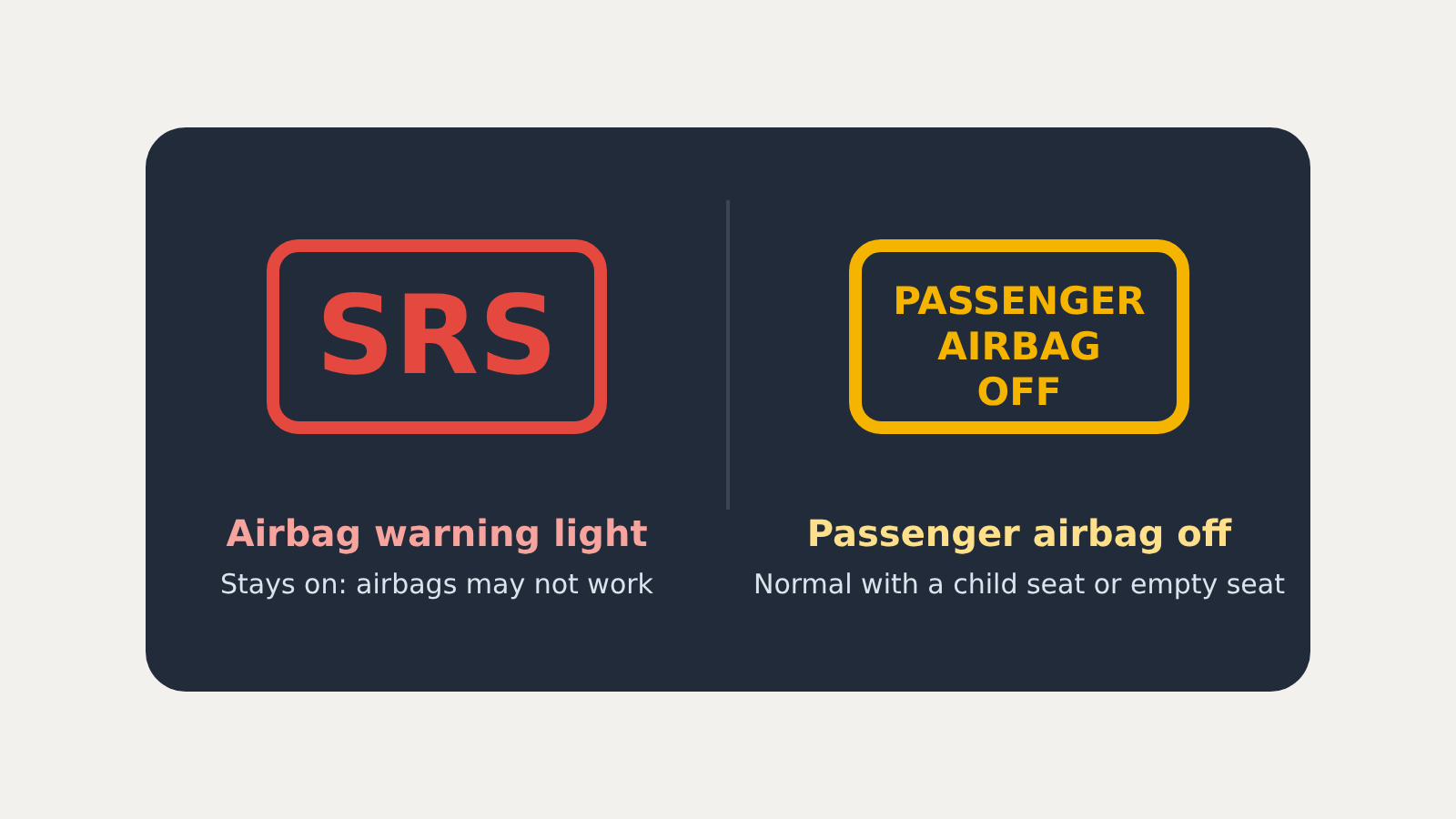
An airbag warning light that stays on after you start the car means the car has found a fault in its airbag system, and the airbags may not inflate in a crash. The car still drives, brakes and steers normally, so you don't need to stop at the roadside, but this is a "fix soon" warning: book a check within days, not weeks, and in the meantime make sure no child rides in the front seat.
The light is usually red. On most cars it shows a seated person wearing a seat belt with a large circle in front of them (the inflated airbag); some cars show the letters SRS (Supplemental Restraint System) or the word AIRBAG instead, or a message in the instrument cluster such as "Airbag fault" or "Service airbag". This applies to cars, SUVs and light trucks of every make. Your owner's manual shows the exact symbol for your model.
Normal: a few seconds at start-up
Each time you switch the ignition on, the airbag light comes on while the system tests itself, then goes out. Kia's owner's manuals give this as about 6 seconds (3 to 6 seconds on some models). If it goes out and stays out, everything passed.
The same manuals list four things that mean the system needs a check:
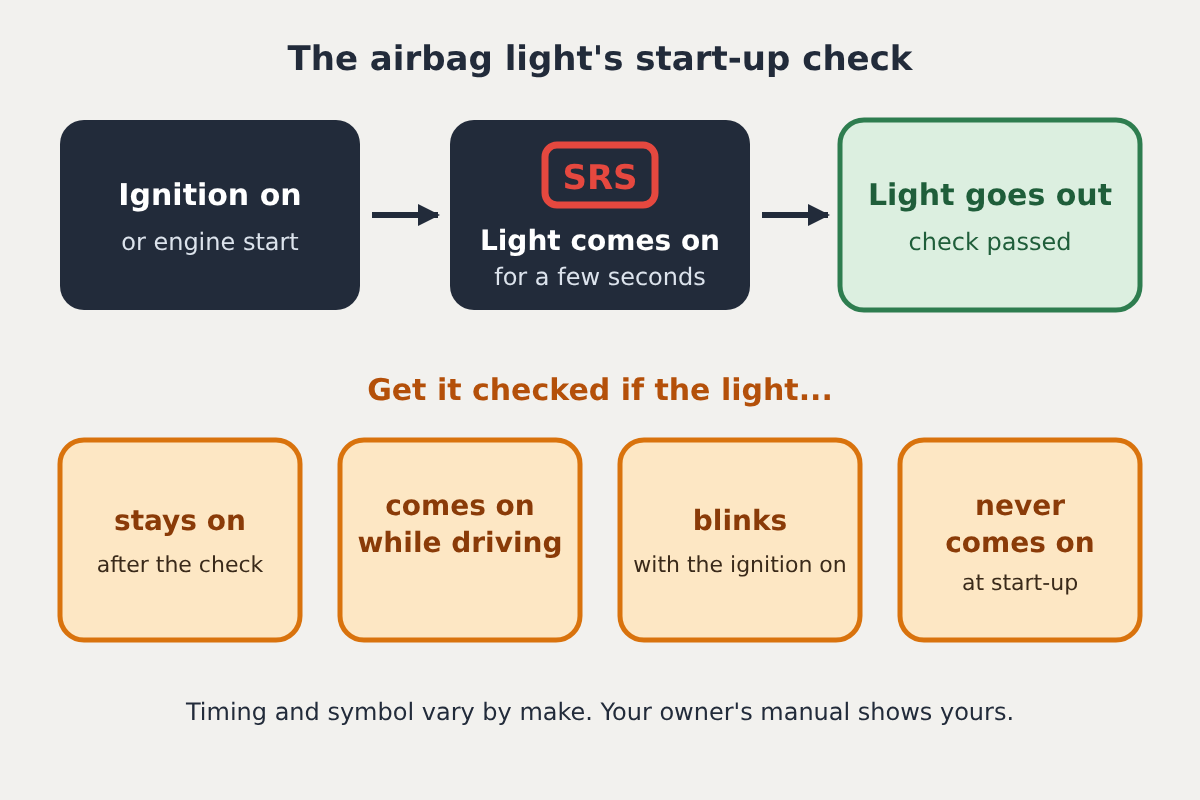
- the light stays on after the self-check
- it comes on while you are driving
- it blinks with the ignition on
- it doesn't come on at all when you switch the ignition on
Ram's owner's manual gives the same list in short: if the light is not on during start-up, stays on, or turns on while driving, have the system inspected at an authorized dealer as soon as possible.
How urgent is it?
The airbag system has no part in steering, braking or the engine, so the light doesn't make the car unsafe to drive in the everyday sense. What changes is what happens in a crash. When the system has logged a fault, it may switch off some or all of the airbags until the fault is repaired, and you can't tell from the driver's seat which ones are affected.
That is why the light is worth fixing quickly even though the car feels fine:
- Keep driving if you need to, but book a diagnosis as soon as you can.
- Wear seat belts on every trip. They are the main protection, and the airbags are designed to work with them.
- Keep children in the back seat, which is where owner's manuals say they should ride anyway. With a fault logged, you can't count on the passenger airbag behaving as designed.
- Check for open recalls. In the US, enter your 17-character VIN at nhtsa.gov/recalls. Airbag recalls are common and the repair is free.
Common causes
A garage reads the fault code stored in the airbag control module, which says which circuit is at fault. Ordinary plug-in code readers usually read only engine codes, the same limit described in our check engine light guide, so ask for a scan of the airbag (SRS) system itself.
The faults that come up most often:
- A connector under a front seat. Seats with side airbags or seat belt sensors have wiring underneath. Sliding the seat hard to its end stop, cleaning under it, or something jammed underneath can pull a plug loose.
- The clock spring. This coiled ribbon cable inside the steering column carries the circuit to the driver's airbag while the wheel turns. When it wears out, the horn or steering wheel buttons often stop working at the same time.
- Seat belt buckle or passenger seat sensors. The car uses them to decide how the airbags fire, and a faulty one sets the light.
- A previous crash. After airbags have deployed, the parts that fired and, on many cars, the control module must be replaced. A used car with the light on may never have had this done.
- Low battery voltage. On some cars a weak battery or a jump start leaves a stored code behind even after the voltage is back to normal.
Don't try these at home
Airbags are fired by a small explosive charge, and the system can store enough energy to set one off for a while after the battery is disconnected. Owner's manuals warn against tampering with airbag parts and wiring for this reason. Don't unplug connectors under the seats or behind the steering wheel to "reset" the system, and don't disconnect the battery to clear the light: if the fault is real, the light returns and you've only hidden it. Leave the diagnosis and repair to a dealer or a qualified repair shop.
The passenger airbag off light is different
Many cars have a second, separate indicator, often near the rear-view mirror or in the centre of the dashboard, reading PASSENGER AIRBAG OFF (or showing a crossed-out airbag symbol). This one is not a fault. A sensor in the passenger seat decides whether the front passenger airbag should be active, and the light tells you what it decided.
In Hyundai's and Mazda's owner's manuals the light is on, and the passenger airbag is off, when the seat holds a child or a child seat, and when the seat is empty. With an adult sitting normally it stays off and the airbag is ready. Hyundai notes that a small adult can be read as a child, and a larger child as an adult, depending on build and posture. It also warns against heavy loads on the passenger seat, items hung on it and anything stored under it.
If an adult is in the passenger seat and the light stays on, Hyundai's advice is to have them sit upright, back against the seat, feet on the floor. If it is still on, they should move to the back seat rather than ride with the airbag switched off. Never put a rear-facing child seat in front of an active airbag.
When the red airbag warning light is on as well, the passenger sensor itself may be at fault. Treat that as a fault and have it checked.
Other lights at the same time
Several warning lights coming on together often point to a common cause rather than several separate faults. If the battery warning light is on as well, get the charging system checked first, then see whether the airbag light clears. Like an ABS light, an airbag light that goes out after a restart has still stored a code, and a garage can read it.
Sources: Kia owner's manuals, "Air bag warning light"; Ram 2500/3500 owner's manual (2022), "Air Bag Warning Light"; Hyundai owner's manuals, "Occupant Classification System (OCS)"; Mazda owner's manuals, "How to Use the Front Passenger Occupant Classification System"; NHTSA recall lookup.
