Traction control or stability control light: flashing, steady or OFF
In short
A flashing car-with-wavy-lines light means traction or stability control is catching a slide right now. A steady light or OFF means it is switched off or has a fault. What each means and whether you can keep driving.
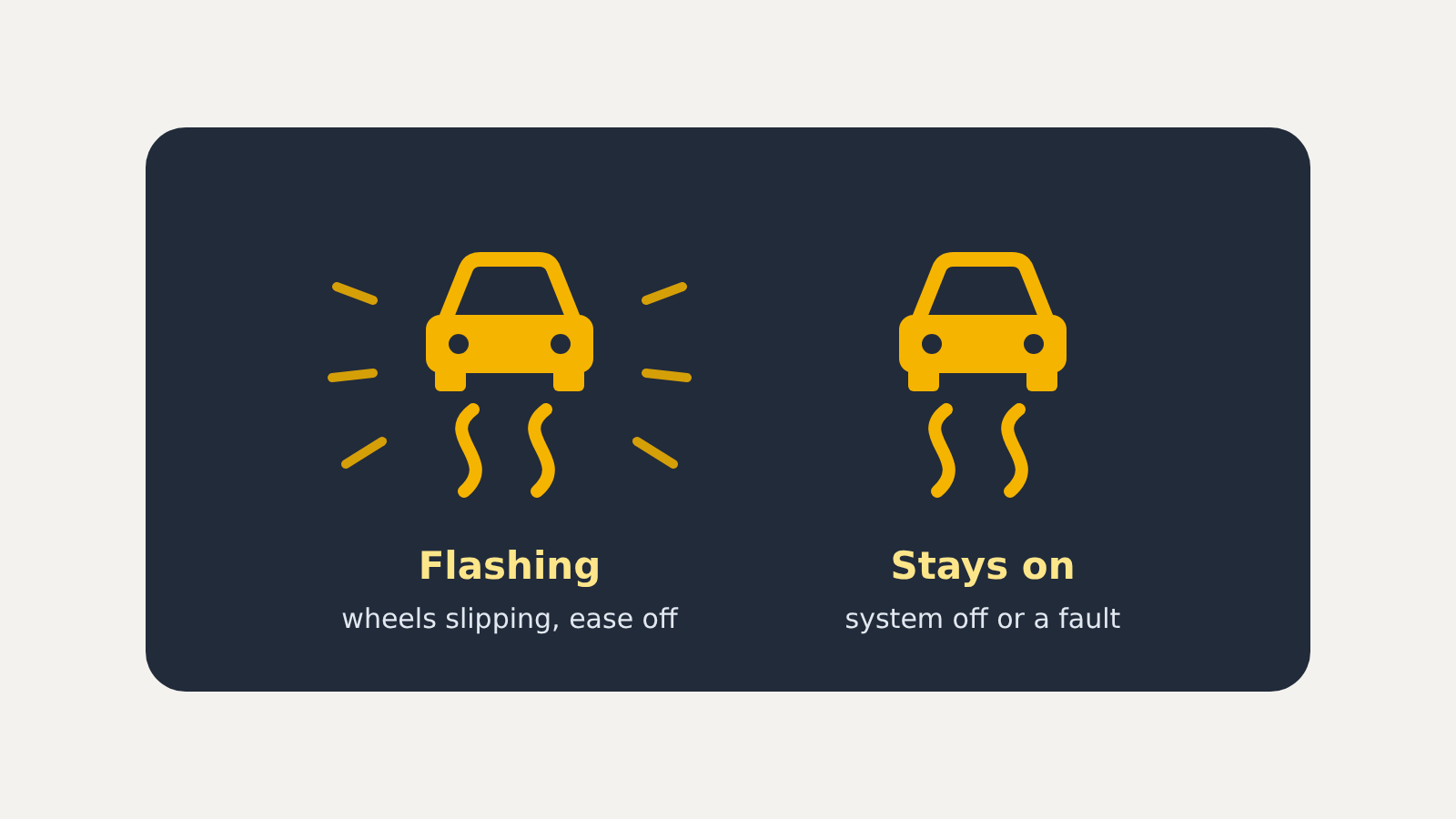
A flashing traction control or stability control light, the amber symbol of a car with two wavy lines under it, means the system is working right now: it has felt a wheel spin or the car start to slide, and it is braking individual wheels or cutting engine power to keep you on your line. Ease off the accelerator and steer smoothly. If the same light stays on without flashing, the system is either switched off or has a fault. That is a "fix soon" warning, not a "stop now" one: the car brakes and steers normally, but it won't catch a skid for you.
This applies to cars, SUVs and light trucks from most makers. In the US, every new passenger car and light truck has had electronic stability control since the 2012 model year, under federal safety standard FMVSS 126, so if your car is newer than that it almost certainly has this light. The exact symbol, colour and wording vary, so check your owner's manual for your model.
What the light looks like and what it's called
The standard symbol is a car seen from behind with two wavy skid marks below it. Makers use different names for the same system:
- ESC (electronic stability control) on many cars, the generic term
- ESP on Mercedes-Benz, Volkswagen, Audi and others
- VSC on Toyota and Lexus, DSC on BMW, VDC on Nissan and Subaru, StabiliTrak on Chevrolet, GMC and Cadillac
- TCS, TC or TRAC for traction control, which stops the drive wheels spinning when you accelerate
On most modern cars traction control and stability control share one light. Some cars show a message in the instrument cluster instead of, or as well as, the symbol, such as "Service StabiliTrak" or "Check VSC System".
Which of the three you are seeing
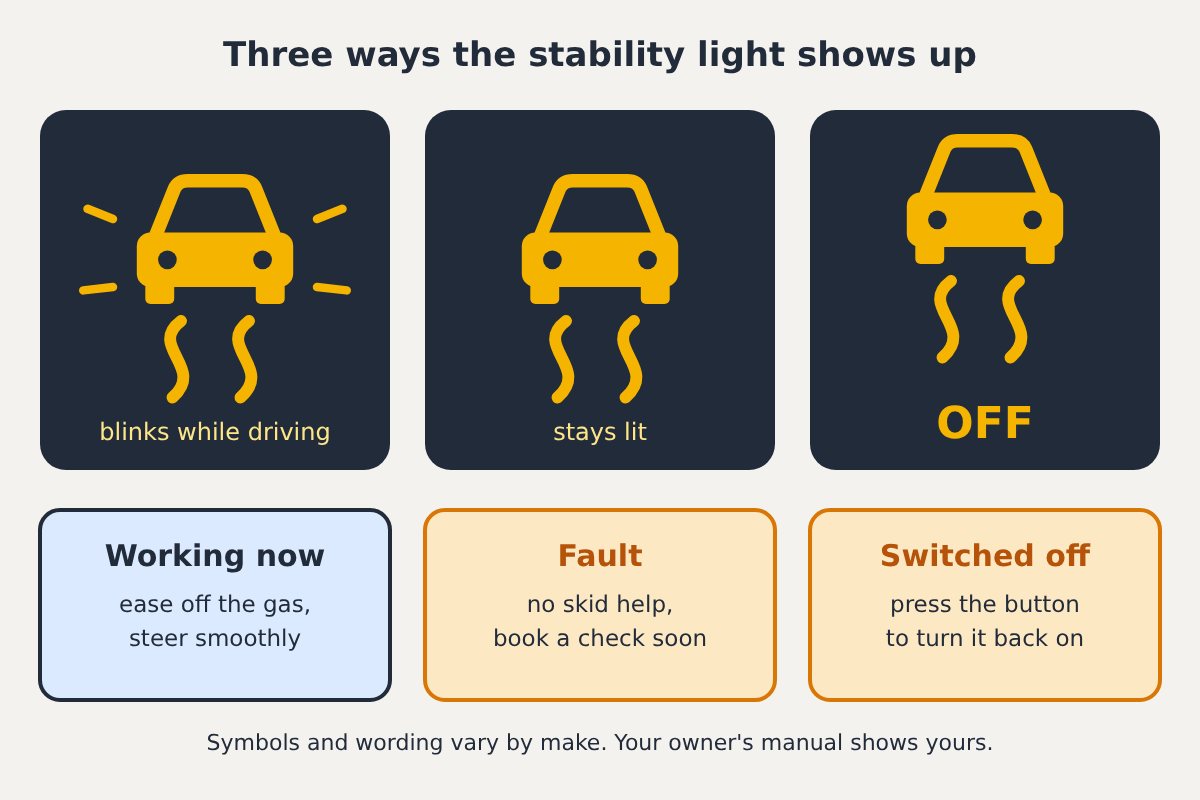
Flashing while you drive. This is normal on snow, ice, wet leaves, gravel or a wet road when you accelerate hard or take a bend a little fast. The light usually flashes for a second or two and goes out once the tyres grip again. Treat it as a hint that the road is more slippery than it feels: slow down, accelerate more gently and leave more room. If it flashes often on a dry road, the tyres may be worn or the pressures uneven, so check them.
Steady, with the word OFF or a separate "OFF" symbol. Someone has pressed the traction or stability button, usually on the dashboard or the centre console. Press it again (some cars need a short press, others a press and hold) and the light should go out. On many cars the system switches itself back on the next time you start the engine.
Steady, without OFF, and pressing the button does nothing. The car has found a fault and switched the system off. You will often see the ABS light come on at the same time, because both systems use the same wheel speed sensors; a fault in one sensor takes out both.
Common causes of a steady light
The system relies on sensors at each wheel and on a steering angle sensor. The usual reasons it shuts down are:
- A faulty or dirty wheel speed sensor, or a damaged wire to it. This is one of the most common causes, and it often brings on the ABS warning light as well.
- A steering angle sensor that needs calibrating, which can happen after a wheel alignment, a battery change or steering work.
- A tyre of a different size from the others, such as a compact spare, which makes one wheel turn faster than the rest.
- A fault the engine computer has found. On many cars, any condition that turns on the check engine light also disables traction and stability control until it is fixed.
- Low battery voltage, which can make several warning lights come on at once.
Is it safe to keep driving?
With the light steady, the car still brakes, steers and accelerates normally. What you lose is the help in a slide: if the car starts to skid on a slippery bend, nothing will brake a wheel to bring it back. On a dry road with gentle driving you are unlikely to notice. In rain, snow or ice, slow down more than usual and leave a bigger gap until it is fixed.
Stop as soon as it is safe if the stability light comes on with a red warning light, such as the red brake warning light, or if the car pulls, the brakes feel different or the steering is heavy. That points to a fault beyond the stability system.
What to do now
- If the light is flashing, ease off the accelerator and avoid sudden steering or braking. It should go out when the tyres grip.
- If it is steady, look for the OFF symbol and press the traction or stability button once.
- Stop somewhere safe, switch the engine off, wait a minute and restart. A light that came on because of a brief sensor glitch may go out after a restart, though a stored fault often keeps it on.
- Check that all four tyres are the same size and properly inflated. The correct pressures are on a label inside the driver's door frame.
- If the light stays on, book a check with a garage or dealer. Many basic code readers only read engine codes, so ask for a scan of the brake and chassis systems, where stability faults are stored.
Some owner's manuals describe switching traction control off for a short time to rock a car free from deep snow or mud, because spinning the wheels a little helps there. If yours does, follow its steps and switch the system back on as soon as you are moving. Leave it on for normal driving.
