ABS warning light: what it means and whether you can keep driving
In short
An amber ABS light that stays on means anti-lock braking is switched off because of a fault. Your normal brakes still work, but the wheels can lock in a hard stop. When it is safe to drive, when to stop, and the usual causes.
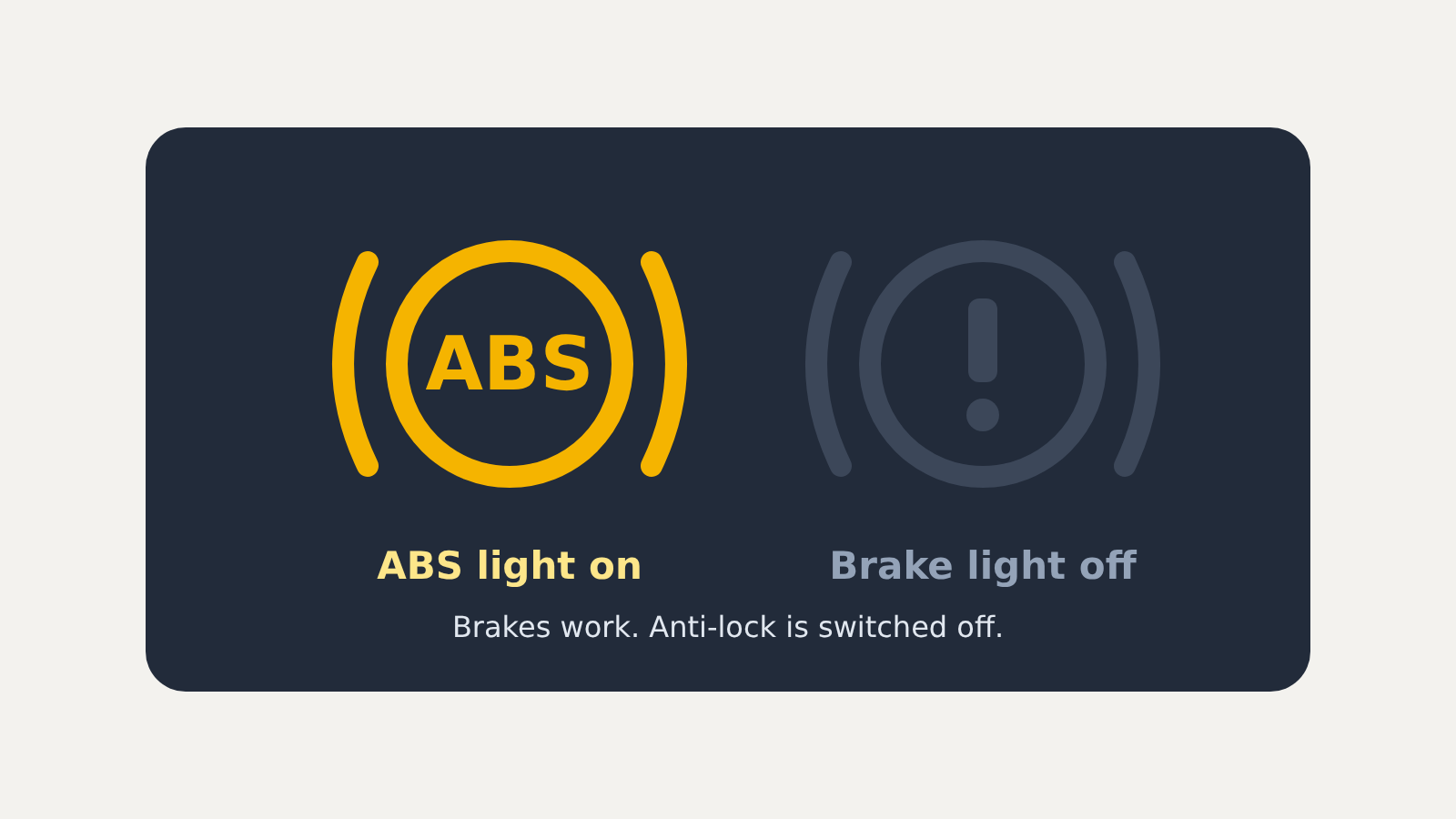
An amber ABS light that stays on means the car has found a fault in its anti-lock braking system and has switched anti-lock off. Your normal brakes still work, so on its own it is a "fix soon" warning: you can drive carefully to a garage, but brake earlier and leave more room, because in a hard stop the wheels can now lock and skid. If the ABS light comes on together with the red brake warning light, treat it as "stop now".
The light is usually the letters ABS inside a circle, with curved brackets on each side, in amber or yellow. Some cars show a message in the instrument cluster as well, such as "ABS fault" or "Service ABS". This applies to cars, SUVs and light trucks of every make; your owner's manual shows the exact symbol and wording for your model.
Normal: on for a moment at start-up
When you switch on the ignition, the ABS light comes on for a few seconds as a self-check and then goes out. That is normal. If it goes out before you drive off, there is nothing to do.
What ABS does, and what you lose without it
In an emergency stop, a wheel that locks stops turning and slides. A sliding front wheel can't steer the car. ABS watches the speed of each wheel through a sensor at every hub, and when one starts to lock it releases and reapplies that brake many times a second, so the wheel keeps turning and you can still steer around something while braking hard. You feel this as a rapid pulsing in the pedal, which is normal.
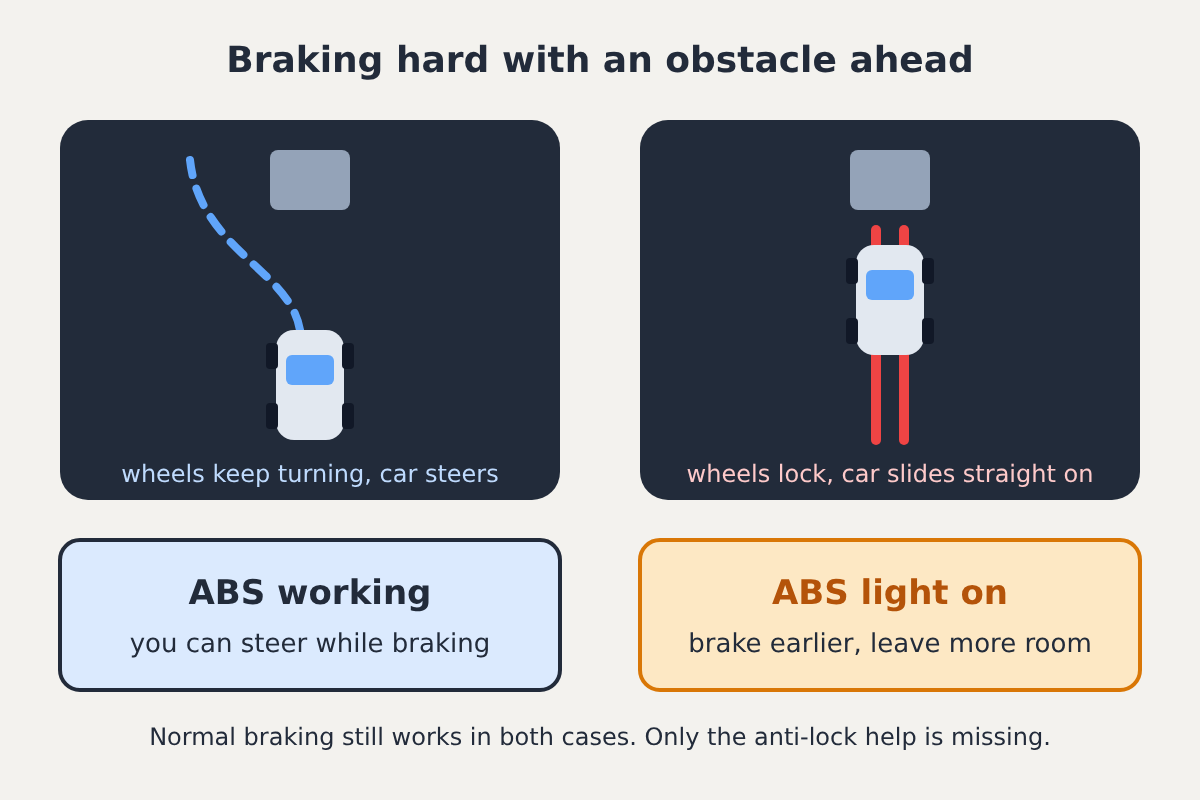
With the ABS light on, braking feels the same in ordinary driving. The difference only shows when you brake hard, especially on a wet, icy or gravel road: the wheels can lock, the car may slide straight on, and it can take longer to stop.
ABS light with other lights
ABS and red brake light together. On many cars this means the system that shares braking between the front and rear wheels has failed too, or the brake fluid is low. The rear wheels can lock early and the car can spin in a hard stop. Pull over when it is safe and follow the steps for the red brake warning light before driving any further.
ABS with traction or stability control lights. These systems use the same wheel speed sensors, so one sensor fault usually switches them all off. Our guide to the traction and stability control light explains what that light means on its own.
Several lights at once, including the battery light. Low voltage can make the ABS module and other systems report faults. If the battery warning light is also on, deal with that first.
Common causes
A garage will read the fault code stored in the ABS module, but these are the usual culprits:
- A wheel speed sensor that is faulty, covered in dirt or brake dust, or has a damaged wire. Each wheel has one, and they sit low down, exposed to water, salt and stones.
- A damaged or rusted toothed ring (tone ring) that the sensor reads on the hub or driveshaft.
- A blown fuse for the ABS pump or module.
- Low brake fluid. On some cars the fluid level switch turns on the ABS light as well as the brake light.
- A fault in the ABS pump or control module itself, which is the most expensive repair and less common than a sensor.
- A tyre of a different size from the others, such as a compact spare, which can confuse the wheel speed readings on some cars.
What to do now
- Check whether the red brake light is also on. If it is, or the pedal feels soft or sinks further than usual, stop when it is safe and don't drive on.
- If only the ABS light is on, drive gently, brake earlier than usual and keep a longer gap, especially in rain or snow.
- When you can, stop, switch the engine off for a minute and restart. If the light goes out and stays out, the fault may have been brief, but a garage can still read the stored code.
- With the engine off, check the brake fluid level against the MIN and MAX marks on the reservoir. Low fluid needs a garage, not just a top-up.
- Check that all four tyres are the same size and correctly inflated.
- Book a check soon. Many basic plug-in code readers only read engine codes, so ask for a scan of the ABS system itself.
Don't pull fuses or unplug sensors to make the light go out. That only hides the fault and leaves you without anti-lock braking when you need it.
