Samsung washer UE or Ub error: why it stops spinning and how to fix it
In short
UE or Ub on a Samsung washer means the load is unbalanced and the spin has stopped. Here is why it happens, the quick fix with a couple of towels, and when it points to a worn part.
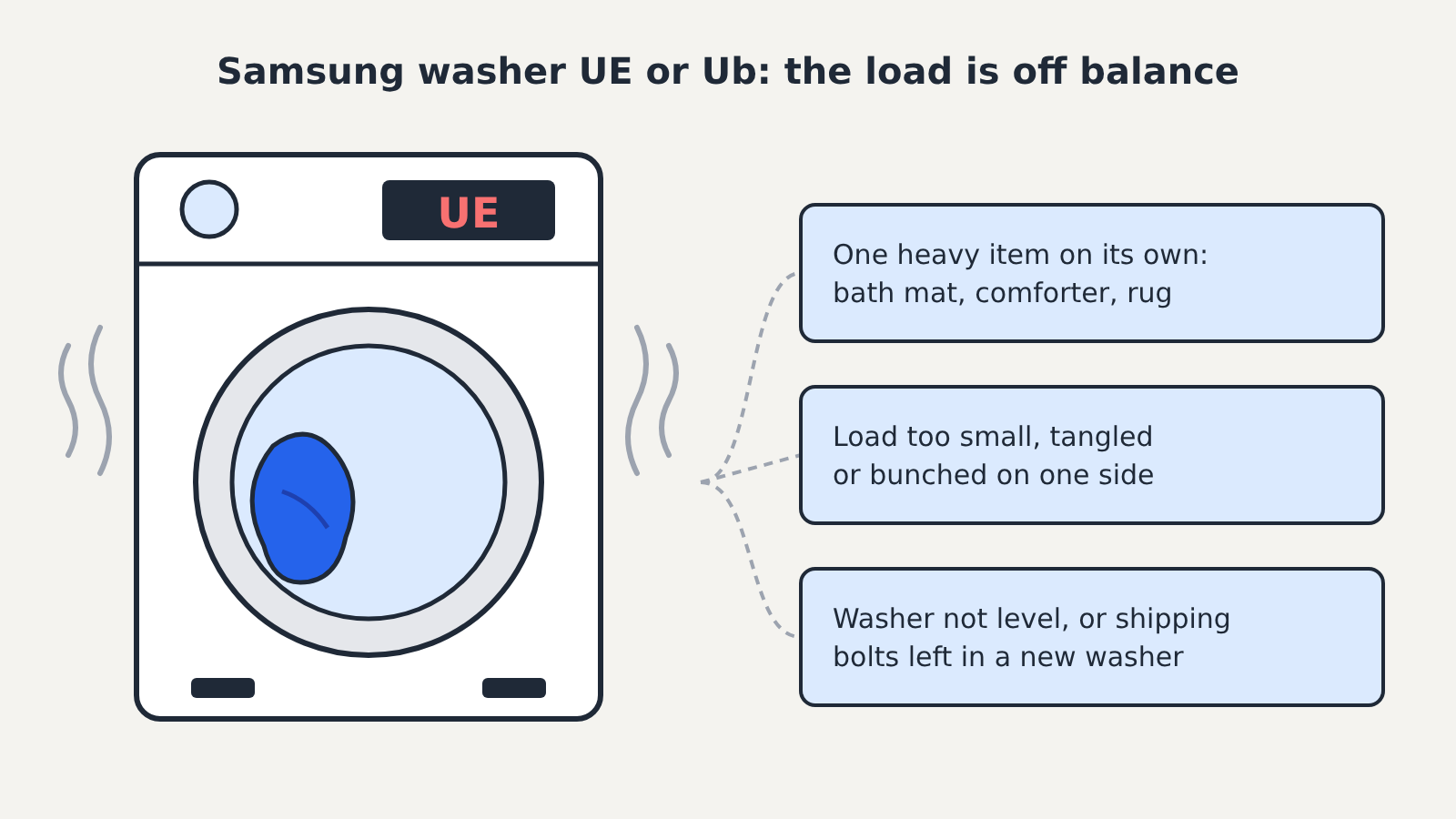
On a Samsung washing machine, UE (also shown as Ub, Ur, U6 or 1Ub depending on the model) means the washer has detected an unbalanced load and stopped the spin to protect itself. It is a fix-soon message, not an emergency: the washer is not broken, and in most cases the fix takes two minutes and an extra towel. The exception is a washer that bangs, jumps or walks across the floor before the code appears. Stop the cycle and work through the steps below before you run it again.
This applies to Samsung front-load and top-load washers. Samsung's own support pages list UE, Ub, Ur, U6 and 1Ub as unbalanced-load codes. One code needs care: dc means an unbalanced load on some Samsung models but a door error on others, so check the error code table in your model's manual before you assume which one you have.
What the washer is telling you
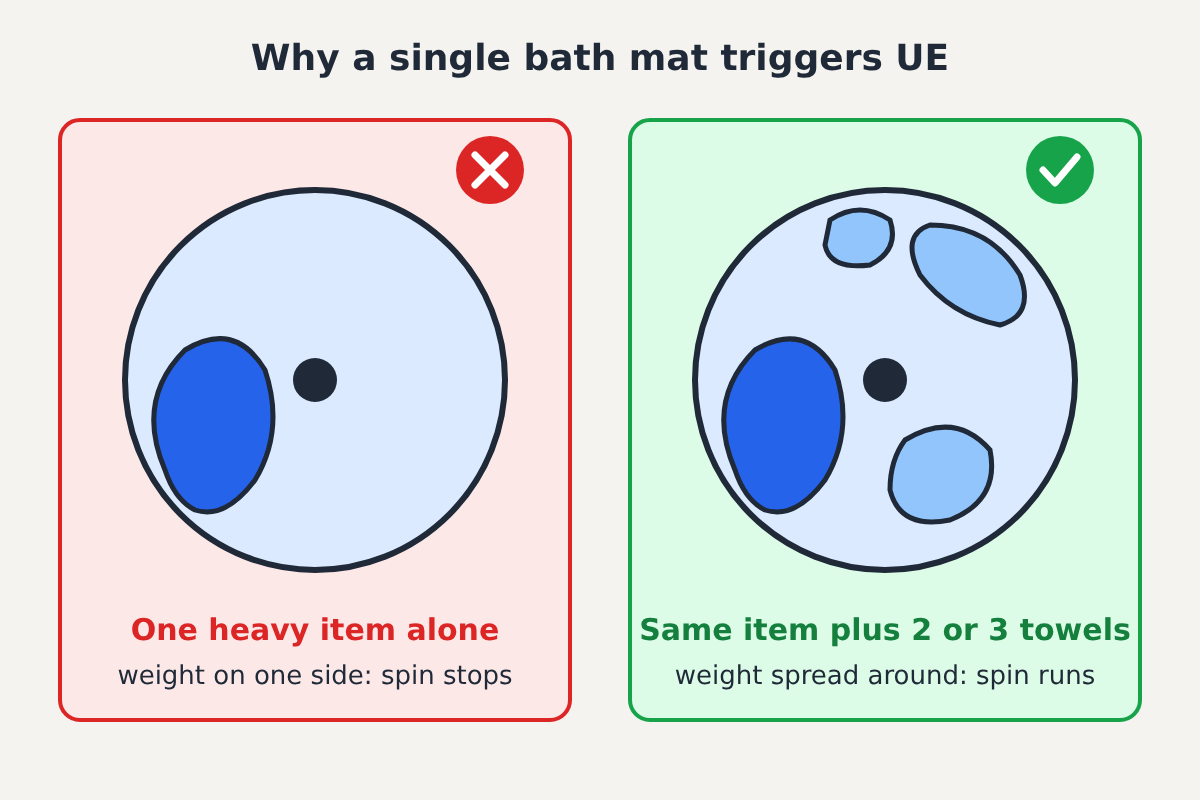
When the drum spins fast, any heavy lump of wet laundry sitting on one side pulls the whole tub off centre. The washer measures this before and during the spin. If the load is lopsided it tries to fix it: it slows down, tumbles the clothes, and on some models adds a little water and tries the spin again. Samsung describes Ur this way, as the washer rebalancing and retrying, not as a fault. When those attempts fail, the cycle stops with UE or Ub, and the clothes usually come out wetter than normal.
The usual causes, most common first:
- A single heavy or absorbent item washed on its own: a bath mat, a rubber-backed rug, a comforter, a sleeping bag or a pair of jeans.
- A very small load. Two or three items can't spread evenly around the drum.
- Bedding that has wrapped itself into a ball, often with smaller items trapped inside a duvet cover.
- A washer that isn't level or stands on a soft or uneven floor.
- On a newly installed front-loader, shipping bolts still fitted in the back.
- Less often, a worn part such as the suspension or shock absorbers, or a fault in the sensor that measures the load.
How to fix a UE or Ub error
Work down the list and stop when the spin finishes without the code.
- Open the door and spread the load out. Pause or cancel the cycle and wait for the door lock to release. Untangle anything that has balled up, pull small items out of duvet covers and pillowcases, and spread everything around the drum. Then run a Rinse+Spin or Spin cycle to finish the job.
- Add or remove items. Samsung's advice for a single heavy item is to add two or three towels and run another spin. If the drum is packed full, take a few things out instead: an overloaded drum can't tumble the clothes into balance either.
- Use the right cycle for bulky things. Wash comforters and sleeping bags on the Bedding cycle if your model has one, one item at a time, and check the manual for the largest item your drum can take. Don't wash a rubber-backed bath mat with nothing else.
- Turn the washer off and on. Samsung's support pages suggest this once the load is sorted. Switch it off at the power button, wait about a minute, and start a Spin cycle.
- Check that the washer is level. Rock it gently by the top corners. If it wobbles, adjust the feet until all four touch the floor firmly, then tighten the lock nuts so they stay put. A spirit level on the top, front to back and side to side, helps here. Samsung's guidance is that the washer should sit on a flat, stable surface; a soft floor or a raised platform that flexes can keep the error coming back.
- On a new front-loader, check for shipping bolts. These hold the drum still while the washer is in transit and must come out before it is used. If the washer was installed recently and shakes badly from the very first spin, look at the back panel for bolts with plastic spacers that are still in place. Samsung's installation instructions show where they are and how to remove them. Washing with them in can damage the washer.
- Run a calibration if your model supports one. Samsung's UK support page describes a weight-sensor calibration for UE errors on some front-loaders: empty the drum, turn the washer off and on, hold the Temp and Delay End buttons until CB appears, then press Start/Pause. The drum turns for about three minutes and then the washer switches off. Button names differ, and some models calibrate themselves, so only do this if your manual describes it.
When it needs a technician
If UE or Ub keeps appearing on a normal mixed load, with the washer level and the load spread out, the problem is probably inside the washer. Worn suspension rods or shock absorbers let the tub swing too far, and a faulty sensor can misread the load. Samsung's support pages advise contacting Samsung or a qualified repair technician at that point. The same goes for loud banging, a drum that sits visibly lower on one side when empty, or a washer that moves across the floor even with a light load. Unplug it and stop using it until it has been checked, and if it is still under warranty, contact Samsung before booking anyone else.
Codes that look similar but mean something else
A washer that stops with water still in the drum has a drainage problem, not a balance problem, and a heavy waterlogged load will then fail the spin too. Our guide to the LG washer OE error walks through what a blocked drain looks like and how to clear the filter, and the same checks apply to most front-loaders. If your Samsung shows 4C or 4E at the start of a cycle, it isn't getting enough water in; see what Samsung's 4C code means. And if the code is dc, look it up in your manual first: on some models it points to the door, not the load.
Avoiding it next time
Most UE errors come from the same few loads. Mix big and small items so the drum has something to balance, wash rugs and bath mats with a couple of towels, keep duvet covers buttoned or zipped so smaller things can't get trapped inside, and don't fill the drum past the line your manual shows. If the code only ever appears with one particular item, that item is the cause, and washing it with others or on the Bedding cycle is the fix.
