LG washer OE error: why it won't drain and how to fix it
In short
OE on an LG washer means water is stuck in the drum. Here is how to drain it, clean the pump filter and check the hose, and when it needs a repair.
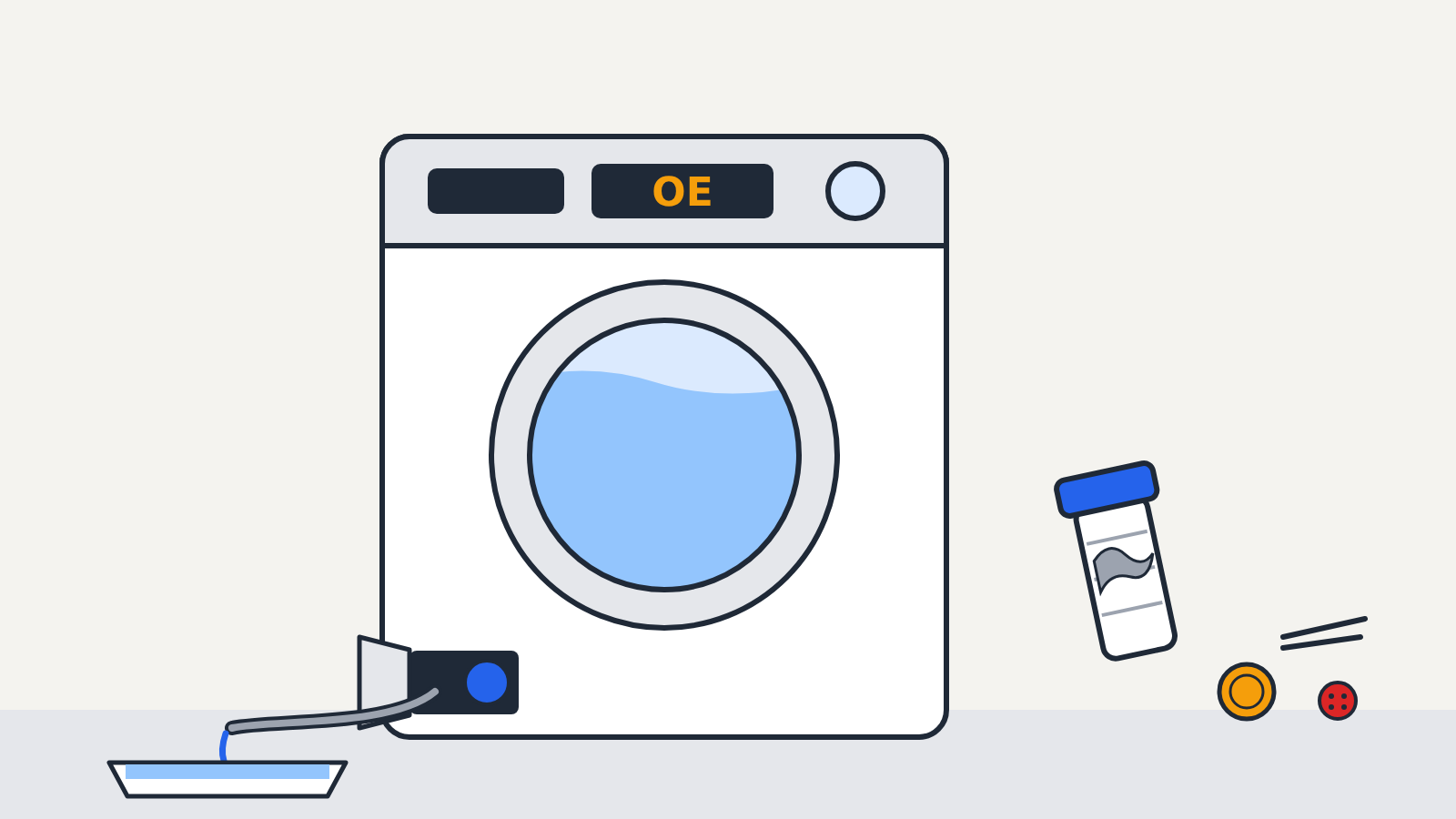
OE on an LG washer means the machine tried to pump the water out and couldn't do it in time, so it stopped with water still in the drum. It's a fix-soon problem, not an emergency: the washer won't hurt itself while it waits, but your laundry is sitting in dirty water and the cycle won't finish until the water can get out. The cause is usually a blocked drain pump filter or a kinked or frozen drain hose, and you can clear both yourself.
This applies to LG front-load and top-load washers, including washer-dryer combos, that show the code on the display. Some displays make it look like 0E (zero-E); it's the same code. LG's owner's manuals and support pages list OE as the drain error. Check your own manual for the exact filter location on your model.
Safety first
You'll be letting out water that may still be hot, next to a machine plugged into the mains.
- Unplug the washer before you open anything. If water has already spread to the wall socket, switch the circuit off at the breaker before touching the plug.
- If the last wash was hot, wait for the water to cool before draining it.
- Expect more water than you think. A front-loader can hold several litres when it stops mid-cycle. Have towels and a shallow tray or baking dish ready, since a bucket won't fit under the drain tube.
Step 1: Restart it and run a drain-only cycle
A brief blockage, such as a sock that shifted, sometimes clears on its own.
- Unplug the washer for a couple of minutes, then plug it back in.
- Press Power, choose Rinse+Spin (or Spin Only on models that have it) and press Start.
- Listen. A steady hum with water moving through the hose means the pump is working. If it drains and spins, run an empty rinse to be sure and carry on as normal.
If OE comes back, keep going.
Step 2: Check the drain hose
The grey corrugated hose at the back carries the water to your standpipe or sink. It's the easiest part to check and the most common cause of OE right after a washer has been moved.
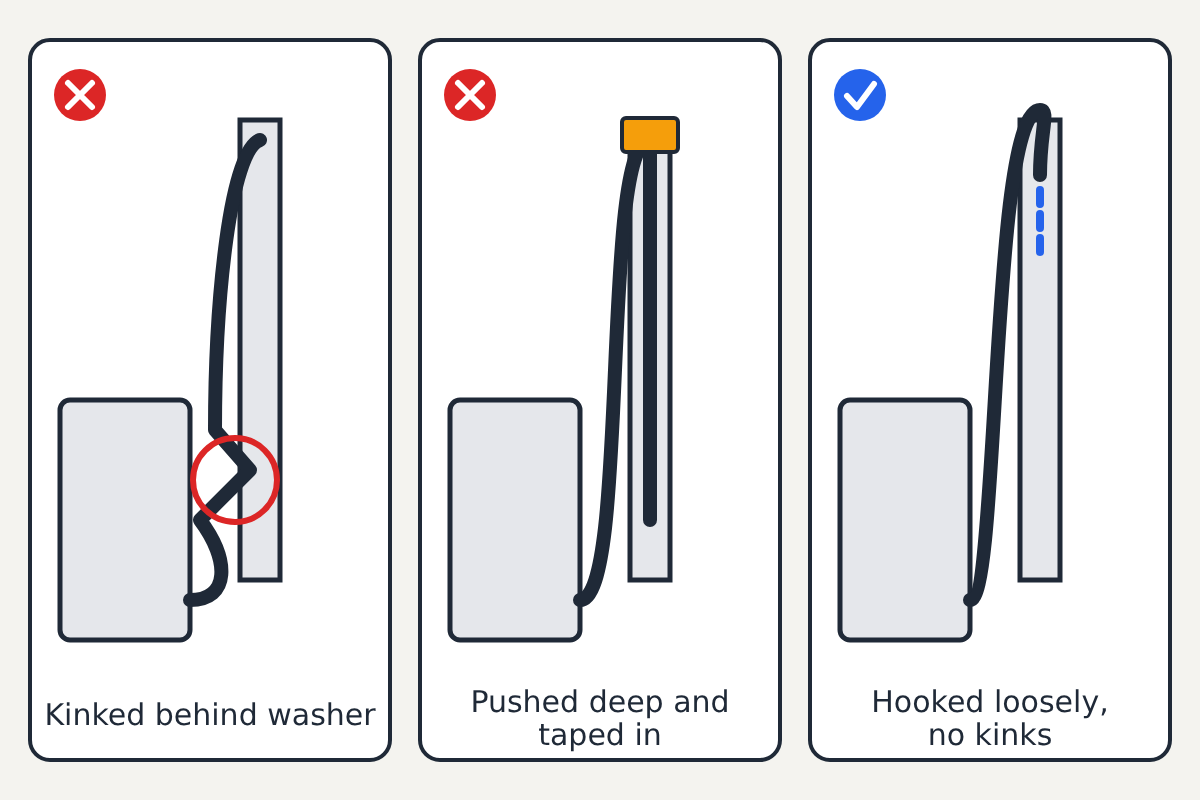
- Kinks and crushing. Pull the washer forward a little and follow the hose all the way. A fold where the washer was pushed against the wall is enough to stop it draining.
- How it sits in the standpipe. The hose should hook loosely into the pipe. LG's installation instructions warn against forcing extra hose into the standpipe or sealing the gap with tape, because an airtight fit can cause siphoning and drain problems. Your manual gives the height limits for your model.
- Frost. If the washer sits in a garage, basement or utility room that drops below freezing, water left in the hose or pump can freeze and block the drain. Let the room warm up before you try again; warm towels wrapped around the hose and the bottom front of the machine speed it up. Then run Rinse+Spin. Don't pour boiling water over plastic parts.
- A blocked standpipe or sink. If the house drain itself is slow, the washer can't empty into it. Pour a bucket of water into the standpipe: if it backs up, the blockage is in the house plumbing, not the washer.
Step 3: Clean the drain pump filter (front-loaders)
On LG front-loaders the drain pump filter sits behind a small cover at the bottom front of the machine, usually in the left corner. It catches coins, hair grips, buttons, lint and small socks before they reach the pump, and when it fills up, OE follows.
- Unplug the washer and lay towels on the floor.
- Open the small access cover with your fingers or a coin.
- Pull out the short drain tube next to the filter, hold its end over your tray and remove the cap. Let the water run out. Cap it and empty the tray as often as you need to; this can take several rounds.
- When the water stops, turn the filter cap anticlockwise and pull it out. A little more water will come with it.
- Clear out everything caught inside, rinse the filter under the tap, and look into the opening with a torch for anything still stuck near the pump.
- Put the filter back in and turn it clockwise until it's firm, refit the drain tube cap, close the cover and run Rinse+Spin.
Check the floor after that test run. If water seeps from the filter, it isn't screwed in straight; take it out and refit it.
Most LG top-loaders have no drain filter you can reach from the front, so on a top-loader steps 1 and 2 are your checks. If your manual shows a filter on your model, clean it the way it describes.
Too many suds can look like a drain problem
LG front-loaders are built for HE (high-efficiency) detergent. Too much detergent, or regular non-HE detergent, makes a thick foam that the pump struggles with, and some models show a separate Sud message when they detect it. If you've just changed detergent, use less, choose an HE one, and run an empty rinse to clear the foam.
When OE means a repair
Call LG service or a qualified appliance technician if:
- the filter and hose are clear but OE comes straight back;
- you hear the pump hum but no water moves, which points to a blockage between the drum and the pump or a damaged impeller;
- the pump makes no sound at all during Rinse+Spin, which points to a failed pump or a wiring or control fault;
- water is leaking from underneath the machine rather than from the filter you opened.
Don't take the cabinet apart yourself if the washer is still under warranty, since that can void it. Have your model number ready (on a label inside the door frame or on the back) when you call.
Other LG codes that look similar
OE is only about draining. A few nearby codes are worth telling apart:
- IE: the washer can't fill with water. That's a supply problem (taps, inlet hose or inlet filters), similar to the Samsung 4C fill error.
- UE: the load is unbalanced. Redistribute the clothes and restart the spin.
- dE: the door isn't latching or the lock isn't reporting closed.
- FE: too much water, which can mean a fault in the water valve. Turn off the taps and unplug the washer.
- PE: a fault with the water level sensor, which needs a technician.
If your dishwasher is the one refusing to drain, the same filter-and-hose logic applies: see how to clear a Bosch dishwasher that shows E24 or E25.
