Bosch dishwasher E15 error: what the leak warning means and what to do
In short
E15 on a Bosch dishwasher means water has reached the base tray and the leak protection has tripped. Stop, close the tap, and check for foam and a blocked filter.
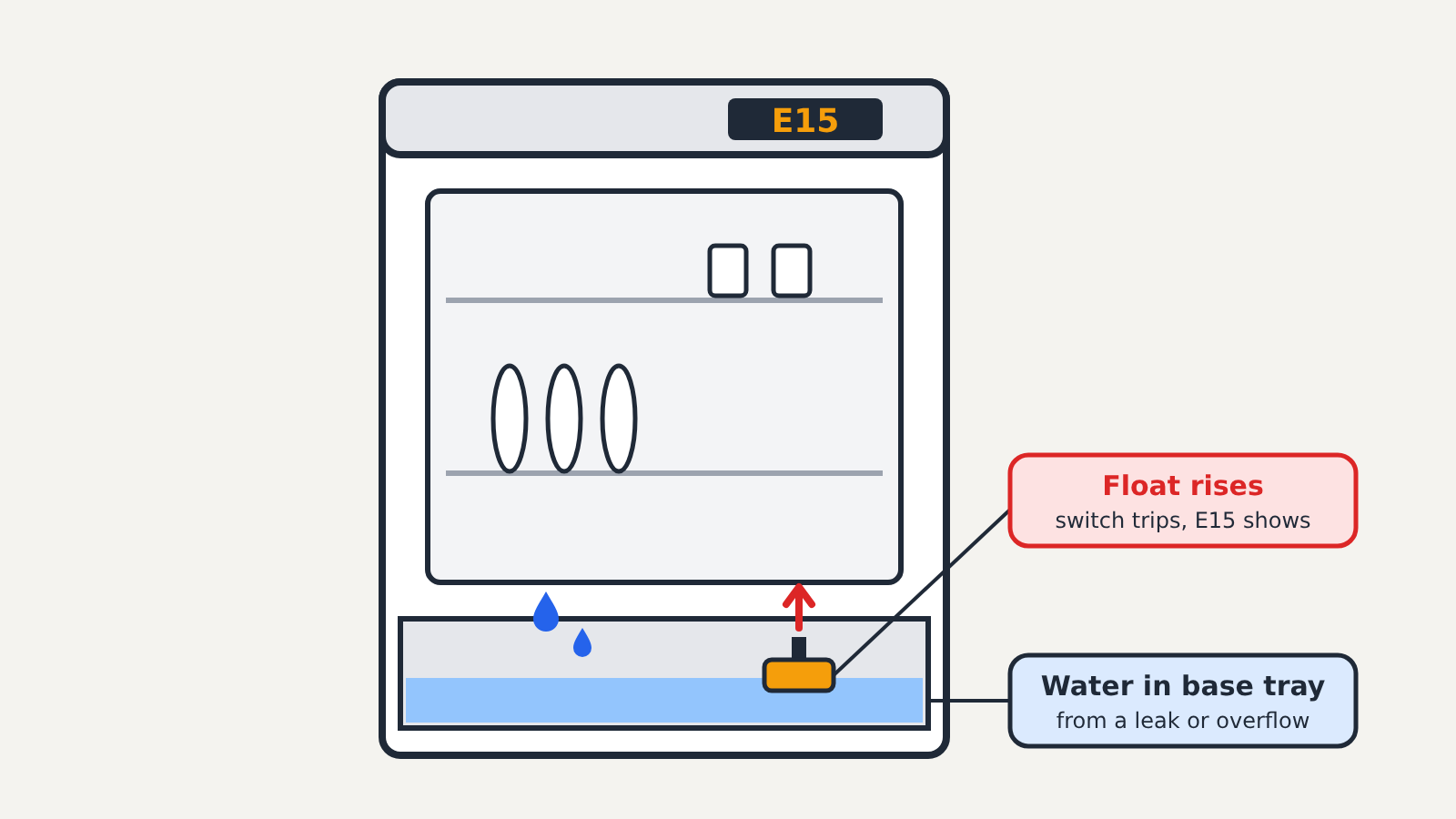
E15 on a Bosch dishwasher means its water protection system has switched on: water has collected in the base tray under the tub, a float switch has risen, and the dishwasher has stopped to keep a leak from reaching your floor. Treat it as stop now. Do not keep running cycles until you know where the water came from.
This code appears on Bosch dishwashers sold in North America, the UK, Europe and elsewhere. Some Bosch support pages list the same message as F15. Siemens dishwashers, made by the same group, use E15 for the same protection system. If your display shows a different code, check your model's manual, because the meaning is not shared across all brands.
Safety first
Water and mains power are close together under a dishwasher. Before anything else:
- Switch the dishwasher off.
- Close the water supply tap (usually under the kitchen sink).
- Unplug the dishwasher or switch off its circuit at the breaker if the plug is hard to reach.
Bosch's own advice for E15 is to close the water supply and contact its customer service. It recommends against repairing the water protection system yourself. Anything inside the base or behind the kick plate is a job for a Bosch engineer or a qualified appliance technician.
What is actually happening
Bosch dishwashers have a sealed tray under the tub. Normally it is dry. When water gets into it, a small float lifts and trips a switch, the drain pump may run to empty the tub, and the display shows E15. So the code tells you two things: there was a leak or an overflow, and the protection system did its job.
The water usually comes from one of these:
- Too much foam. Washing-up liquid, too much detergent, or a rinse aid dose set too high can make suds that push past the door seal and spill into the base.
- A blocked filter. If the filter at the bottom of the tub is clogged, water can back up and overflow.
- A worn or dirty door seal. Food stuck on the gasket, or a seal that has hardened, lets water seep out at the bottom of the door.
- A loose hose or worn internal part. Inlet and drain hose connections, the pump seal and the inlet valve can all leak. These are inside the machine and need a technician.
Checks you can do safely
These are ordinary maintenance tasks from the owner's manual. None of them involve opening the machine.
Check the detergent. Only dishwasher detergent belongs in a dishwasher. If anyone in the house has used washing-up liquid, even a squirt to deal with a greasy pan, that alone can cause enough foam to trigger E15.
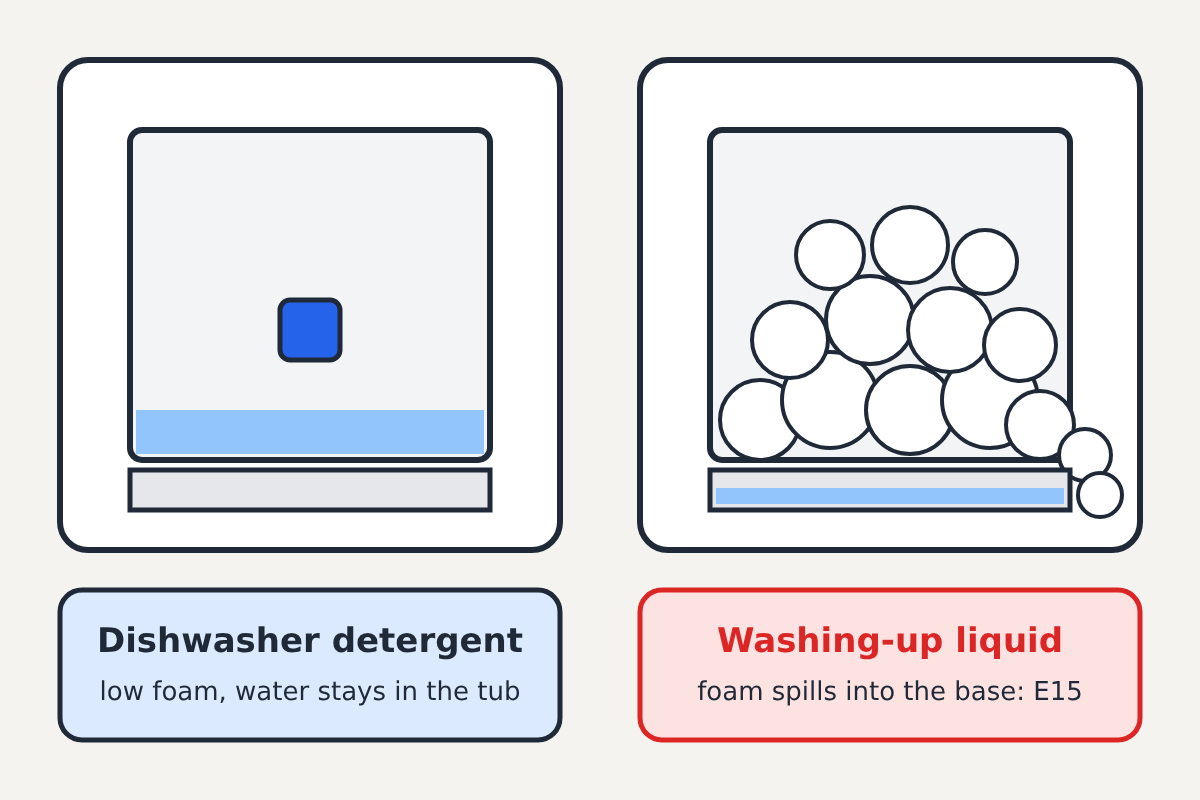
If foam was the cause, leave the door open for a few hours so the suds die down, wipe out what you can reach in the tub, and run the next cycle with the correct detergent only.
Clean the filter. Lift out the cylindrical filter at the bottom of the tub (it twists out on most Bosch models), rinse it under the tap, and refit it until it locks.
Look at the door seal. Wipe the rubber gasket around the door, paying attention to the bottom edge. Look for food, grit, splits or flattened sections.
Check under the sink. With the tap closed, look at the hose connections under the sink with a torch. Damp fittings or drips there point to a loose or failing connection.
Clearing the code
The float drops only once the base tray is dry. You may read online about tilting the dishwasher to empty the tray. That can make the code go away, but it does nothing about the leak, and Bosch does not recommend it. A dishwasher installed under a counter is also heavy and awkward to tilt, and you can damage hoses or the floor doing it.
If you found an obvious cause, such as washing-up liquid, give the machine a day with the door open, then turn the water and power back on and run a short programme while you stay nearby. If E15 returns, or you found nothing, stop and book a repair.
When to call Bosch
Contact Bosch customer service through the support pages on the Bosch home appliances website for your country, or an appliance repair service you trust, if:
- E15 comes back after you have dealt with foam and cleaned the filter
- you see water on the floor or under the sink
- the door seal is split or the hoses look damaged
Tell them the code and your model number (on the label along the edge of the door). If the dishwasher is under warranty, let Bosch do the repair so your cover stays intact.
Washing machines have their own water codes. If your Samsung washer shows 4C, our guide to the Samsung washer 4C water supply error walks through the fixes.
Sources: Bosch Home Appliances support pages on dishwasher error E15 (US, South Africa, Malaysia, Qatar and Kuwait editions).
